I wasn't at all sure we would get much autumn colour in London this year. One or two trees that changed colour dropped their leaves the very next day so this week I took pictures wherever I went. These photographs were all taken this last week of October. And as I write I see that the Japanese Maple across the road is just turning red. It was green yesterday. So there may be more interesting colour to come. Maybe some more red and orange. There seems to be a lot of yellow around this year so far.
Showing posts with label autumn colour. Show all posts
Saturday, 29 October 2016
Wednesday, 11 December 2013
Tree Identification № 2: Cotoneaster
Cotoneaster is a genus of flowering plants with between 70 and 700 species. This seems a hugely vague thing to say but there's obviously something highly technical that makes plants possibly Cotoneaster and possibly not. And I probably don't know what it is.
At any rate there are a number of different types of Cotoneaster (and for those of you who don't know it is pronounced kəˈtoʊniːˈæstər rather than coton-easter) which flourish in this part of London.
There's the flat kind that grows along the ground or up walls which has tiny leaves and flowers on very straight stiff twigs, Cotoneaster prostratus. It seems to grow in every second garden around here. It's happy growing up against walls or under hedges and this year has produced a bumper crop of berries and some gorgeous autumn colour.
Then there's the sort that makes a very handsome hedge. I think it's probably Cotoneaster franchetii because that's what is usually sold as a hedging plant these days. It makes a beautiful hedge with tiny flowers much sought after by bees, and brilliant red berries. You'd think that the berries would be snapped up by the birds but they are usually to be seen well into the winter, even if it has been very cold and food must be scarce. The leaves are quite tough and leathery and about the size of a finger nail (although narrower) and have quite a pronounced point. The central vein is obvious but the lateral veins only really show if you hold a leaf up to the light. Some years C. franchettii has vibrant red autumn colour; this year many local plants have turned a rich crimson.
Many roads in Hampstead Garden Suburb still have the original hedges which were planted in the early years of the 20th century so Cotoneaster hedges can be spotted in Oakwood Road, Denman Drive, Blandford Close and Westholm. They are a welcome change from the now ubiquitous Privet and in fact make a good choice for a small front garden as you get a narrow hedge that doesn't bush out and take up too much room. Impatient modern gardeners want fast growing hedges of Laurel or Photinia or worse, Leylandii. Laurel and Photonia have large leaves which don't look good when you clip the hedge regularly, and as for Leylandii - there's no stopping it. Before you know where you are it's as tall as the house. But plant a little row of Cotoneaster and in a couple of years you'll have a well-mannered hedge that won't need cutting back every week, won't overwhelm your garden, and will benefit the local wildlife.
Also to be found in the Suburb are Tree Cotoneasters. This is simply a term for species of Cotoneaster
When the local Trees & Open Spaces Committee agreed a plan for street tree planting with Barnet Council, high on the list was replacing lost planting schemes so in the late 1990s first one, and then two or three Cotoneaster frigidus were planted in Asmuns Hill. I think C. cornubia was also planted. The planting is still mixed because you don't fell a perfectly healthy tree simply because it doesn't fit your planting scheme. One day perhaps the road will look as originally intended.
Tree Cotoneasters have narrow strap-like leaves (although essentially, er, leaf-shaped), perhaps 7cm long and quite leathery. The veins are quite pronounced giving a slightly quilted effect that doesn't really show in photographs. The white flowers come in clusters and are followed by bunches of pinkish red or bright red berries. The bark is a little like Cherry bark but it's not what you really look at. This is a handsome tree; its main attraction the mass of leaves and fruits although sometimes they seem too heavy for the slender trunk.
![]() |
| Plenty of autumn colour this year |
Sunday, 24 November 2013
Tree Identification № 1: Liquidambar styraciflua or Sweet Gum
Liquidambar styraciflua grows happily in the UK but it's not a native tree. It comes from the southeastern United States, its range stretching roughly from southwestern Connecticut to mid-Florida and then west towards Illinois, southern Missouri and eastern Texas. And it doesn't grow up mountains except in Central America and Mexico where it seems to be part of the cloud forest. That would be fun to see.
The tree was introduced into Europe in 1681 by a missionary plant collector called John Bannister and first grown in the gardens of Fulham Palace, home to Henry Compton the Bishop of London. Bishop Henry seems to have been a really keen gardener and the 17th century was an exciting time with all sorts of new species making their way to Europe. The first time his new Liquidambar produced its fabulous autumn colour must have been a real thrill for him.
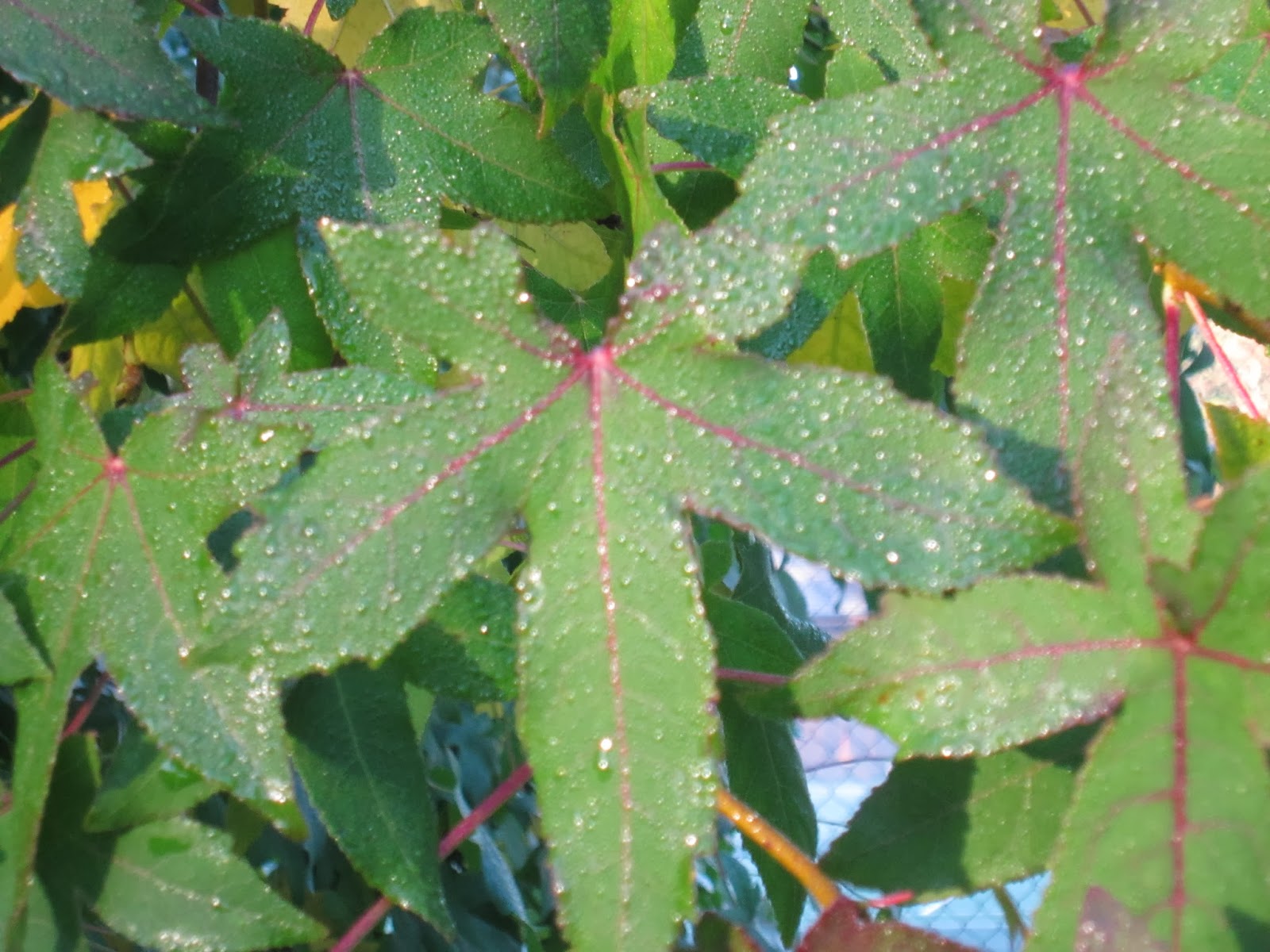
The Liquidambar has bright green hand-shaped leaves which have a lemony scent if you rub them between your fingers. And because the leaves are hand-shaped it is often confused with a Maple. Maples too (the best known Maples at any rate) have hand-shaped leaves and sometimes it's hard for the beginner to tell these trees apart.
Liquidambar leaves grow alternately on the twig. Maple leaves grow in pairs, opposite each other. These trees also have completely different flowers and fruits, and bark, but the alternate/opposite twigs and leaves thing is the most obvious when you get close enough to look. And Maple leaves don't have that smell so if you aren't sure, give them a squeeze.
Liquidambars have strange corky wings on the twig, sort of edgewise plates of bark. Quite difficult to photograph.
This particular tree was planted on Willifield Green in 1997 to celebrate the 90th anniversary of the founding of Hampstead Garden Suburb. Léonie Stephen who was then Chairman of the Residents Association planted it using Dame Henrietta Barnett's ceremonial spade.
You can see here that the leaves and twigs don't grow in pairs and so this cannot be a Maple.

We had lots of sunshine, and blue skies in the autumn of 2010 when I took these three photos. Liquidambar autumn colour can be absolutely stunning with some trees producing yellow, orange and dark red leaves all at once. Other trees restrict themselves to just one colour. I don't know why.
Liquidambars were not originally used as street trees in the Suburb. But when the Red Oaks planted in a short stretch of Hill Top became simply too huge for their position, it was agreed that the Oaks would gradually be replaced with Liquidambars. Which don't grow quite so large, and what's more, although their leaves are full of tannin, they still break down faster than Red Oak leaves do. This is a bonus for residents used to seeing their street and garden fill up with fallen leaves very slow to biodegrade. Red Oak leaves take forever to break down.
![]() |
| © hast.sinica.edu.tw female flower |
![]() |
| © hast.sinica.edu.tw fruit |
It's a really handsome tree with great autumn colour. You need a big garden or a park to get the best from it. If I had a large enough garden (not very likely) I'd certainly plant one.
Wednesday, 13 November 2013
A little autumn colour 2013

I couldn't resist posting some beautiful autumn colour.
First frost of the autumn last night and
lovely blue skies and sunshine on my way to work this morning.
Subscribe to:
Posts (Atom)